
[The Lesson]
[Overview]
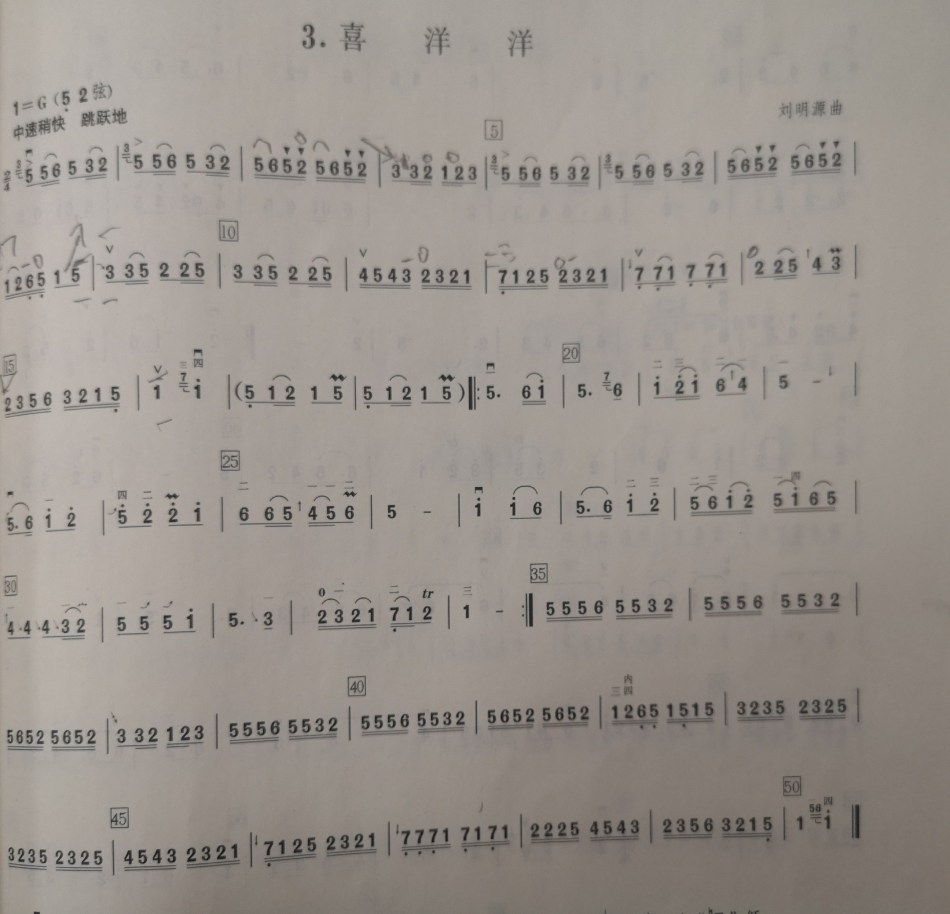
This lesson felt more productive than the last few. I felt like I learned lots of new things and when reviewing the old things I could feel that I made progress. The first part of the lesson was spent going through all the pentatonic scales I’ve learned so far. I’m getting better at switching keys now. I don’t have a strong absolute pitch but I do have somewhat of a reasonable relative pitch. That’s what I rely on to stay in tune, but when I need to quickly play in a different key, I get thrown off. But I’m getting better at doing that, so that’s good. After that, we briefly played through the pieces for my level 2 exam, nothing eventful there. We went on to play through the fast bow exercise. I definitely came a long way with that. My bowing feels more consistant, and I can feel that I have much more control than before. But for today’s lesson the most important was that I got to start playing a new piece called 喜洋洋 (Xi Yang Yang). I don’t know how to translate that phrase so I’m just going to use the Chinese name going forward. We learned the first section so far and I assume we’re going to learn section by section per lesson.
[Technique]
So there were a couple techniques that I really need to work on for this piece to play it well. Since the 二胡 (Erhu) is a folk instrument, the style it’s played in varies greatly across different provinces and ethnicities. So during the exams we are also tested on our ability to play true to the style that it’s written in. One of the techniques I learned called 中立音 (Zhong li yin) is essential to that. A 中立音(zhong li yin) is a note that is sharper than a natural note but not quite a sharped note, or a note that is flat, but not flat enough to be a flatted note; in essence it’s a half semitone. You can find an example of that in measure 13 in the sheet music I attached after this section (it’s the symbol with a straight arrow going down). Although I understood the concept in the lesson, I didn’t know what the proper word in English should be. After a short google search, I found out that it’s apparenly called a “micro-interval”. I don’t know how common it is in western music, but it pops up all the time in Chinese music. I don’t think my ear is good enough to hear such a small interval and be able to play it in tune consistantly but we will see. Another technique essential to this piece is 滑音(Hua Yin) or sliding notes (look for those those huge arrows my teachers drew on my sheet music if you’re wondering what the symbol is). For higher level pieces I already knew that it was an essential technique because it appears a lot. For me, the difficult part right now is getting the timing of it right so that the slide is noticeable but not too much and also in tune. These two techniques are beginner level and essential so I’m going to spend some time this week to really try and have them feel solidified.
[Repertoire]
弓桥泛月, 喜洋洋, 送别, 敖包相会,好一朵茉莉花
This week I studied a new piece called 喜洋洋(Xi Yang Yang).
[Practice]
[This Week’s Goals]
1. Be able to play the first section of 喜洋洋(Xi Yang Yang) at at least 70BPM no stopping.
Have those 中立音(micro intervals) in tune.
Clear slides
Make the clear staccatos where necessary.
2. Be able to play the pentatonic scale exercise straight through with no stopping at 70BPM.
3. Be able to play the vibrato notes clearly in all pieces.
 Devon Said What?
0 comments on “[No. 12] ErHu Practice Log | 二胡練習日誌”